

Betting odds are the language of sports gambling. They tell you how likely something is to happen, how much you stand to win, and — if you know what to look for — where bookmakers have made a mistake. The problem is that odds come in three different formats depending on where you are in the world, and switching between them feels like converting Celsius to Fahrenheit after three pints.
This guide breaks down decimal, fractional, and American odds without assuming you have a maths degree. By the end, you will not only read any odds format on sight but also calculate implied probability and — more importantly — figure out when a price actually represents value.
Significance of Football Betting Odds
At their core, odds do two things. First, they reflect the probability of an outcome. Second, they determine your payout. A match between Manchester City and a newly promoted side will have wildly different odds on each team because the chances of winning are wildly different. So far, so obvious.
What is less obvious is that odds are not a pure reflection of probability. Bookmakers build a margin into every market — sometimes called the overround, vig, or juice — which ensures they make money regardless of the result. That margin is why the implied probabilities on a two-way market always add up to more than 100%. The bookmaker is effectively charging you for the privilege of betting, and understanding odds means understanding that tax.
Odds also shift constantly. Opening lines might favour the home team at a certain price, but as money flows in from the public, the bookmaker adjusts. Injuries, team news, weather — all of these push the numbers around. Knowing how to read odds is step one. Knowing that the numbers are a moving target is step two.
Decimal Odds: The European Standard
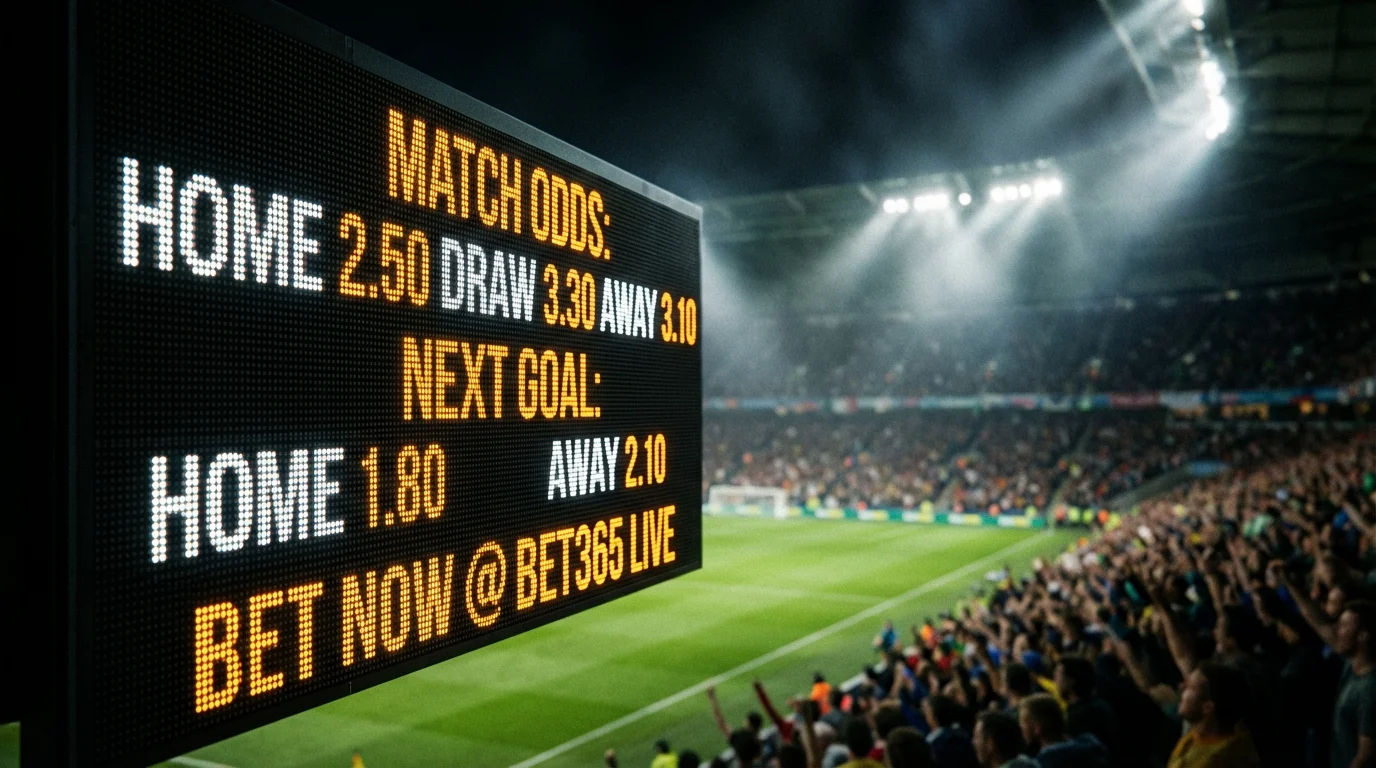
Decimal odds are the most straightforward format. The number you see is the total return for every unit staked, including your original bet. If the odds are 2.50, a 10-unit stake returns 25 units total — your 10 back plus 15 in profit.
The beauty of decimals is that comparing value takes about half a second. Higher number, bigger payout, lower implied probability. You do not need to do mental gymnastics with numerators and denominators. Just multiply your stake by the decimal, and that is your total return. It is the format used across most of Europe, Australia, and increasingly the rest of the world, largely because it removes the friction that fractional odds introduce.
Calculating implied probability from decimal odds is equally clean. Divide 1 by the decimal, then multiply by 100 to get a percentage. Odds of 2.50 give you 1 / 2.50 = 0.40, or 40% implied probability. Odds of 1.80 give you roughly 55.6%. Once this formula is second nature, you will scan betting markets the way a currency trader scans exchange rates — quickly, and with a clear sense of what is cheap and what is expensive.
One small caveat: decimal odds can sometimes look deceptively close together. The difference between 1.90 and 2.00 is only 0.10 on paper, but in implied probability terms that gap represents about 2.6 percentage points. Over hundreds of bets, those margins determine whether you finish the season profitable or broke.
Fractional Odds: The British Tradition
Fractional odds are the format you will encounter across UK and Irish bookmakers, at racecourses, and in the majority of British football coverage. They express profit relative to stake: 5/1 means you win five units for every one unit staked; 4/6 means you win four units for every six staked.
Reading fractional odds requires a small mental adjustment. The number on the left is your potential profit and the number on the right is your stake. When the left number is bigger, the outcome is considered unlikely (a “long shot”). When the right number is bigger, the outcome is the favourite. So 10/1 on a lower-league club reaching a cup final means the bookmaker considers it a roughly 9% chance. Meanwhile, 1/5 on Manchester City beating a relegation candidate means the bookmaker sees it as an 83% probability.
Converting fractional odds to implied probability follows a simple formula: divide the denominator by the sum of both numbers, then multiply by 100. For 5/1, that is 1 / (5 + 1) = 16.7%. For 4/6, that is 6 / (4 + 6) = 60%. It is not complicated, but it is slower than decimal conversion, which is one reason the global market has been drifting towards decimals for years. Fractional odds also get awkward at unusual prices — try parsing 11/8 or 100/30 quickly in your head. Bookmakers know this, which is why most platforms now let you toggle between formats.
Where fractional odds retain an edge is in how naturally they communicate payout. Telling someone “you get five to one” is instantly understood. Telling someone “the decimal is 6.00” conveys the same information but with less dramatic flair. There is a reason commentators and tipsters still lean on fractional language — it sounds better in conversation, even if decimals are more practical on a screen.
American Odds: The Moneyline System
American odds — also called moneyline odds — centre on the number 100 and come in positive or negative form. A positive number like +250 tells you how much profit you make on a 100-unit stake: bet 100, win 250, collect 350 total. A negative number like -150 tells you how much you need to stake to win 100 in profit: bet 150, win 100, collect 250 total.
The logic is internally consistent but takes some getting used to if you grew up with decimals or fractions. Positive numbers represent underdogs; negative numbers represent favourites. The larger the negative number, the heavier the favourite. A team at -400 is a near-certainty in the bookmaker’s estimation, while +400 on the other side implies a roughly 20% shot. In NFL and college football markets, American odds dominate entirely, so anyone betting on American football needs to become fluent in this format regardless of where they live.
Implied probability conversion differs slightly for each side. For positive odds, the formula is 100 / (odds + 100). So +250 gives you 100 / 350 = 28.6%. For negative odds, flip it: take the absolute value, then use odds / (odds + 100). So -150 gives you 150 / 250 = 60%. The symmetry is elegant once you see it, though most bettors simply let their platform convert for them. The real skill is recognising when the implied probability does not match your own assessment of the game.
How to Calculate Implied Probability Across Formats
Implied probability is the percentage chance an outcome has according to the bookmaker’s price. It is the single most important concept in betting because it turns abstract numbers into something you can compare with your own opinion. If you believe Liverpool has a 50% chance of beating Arsenal, but the odds imply only 40%, there is a gap — and that gap is where profit hides.
The formulas themselves are worth memorising. For decimal odds, divide 1 by the odds. For fractional odds, divide the denominator by the sum of both numbers. For American odds, the two formulas given above apply depending on whether the odds are positive or negative. In practice, most seasoned bettors pick one format they are comfortable with and mentally convert everything else into that format. Decimal is the easiest for quick maths, which is why it is the default on most international platforms.
Once you have the implied probability, add up all outcomes in a market. A two-way market (home win or away win in a match with no draw option) should total 100% in theory, but in practice it will total something like 105-110%. That excess is the bookmaker’s margin. The tighter the margin, the better the odds for the bettor. Shopping for bookmakers with lower overrounds is one of the simplest ways to improve long-term results — it costs nothing, requires no additional analysis, and shaves the house edge bit by bit.
Spotting Value: When the Price Is Wrong
Value betting is the foundation of profitable sports wagering. A bet has value when the odds offered are higher than the true probability of the outcome. It is not about picking winners — it is about finding prices that are too generous relative to the actual chance of that thing happening.
Consider a Champions League group match where you estimate the home team has a 55% chance of winning. If the bookmaker offers odds of 2.00 (implying 50%), you have a value bet — the price is wider than your assessment warrants. If instead the odds are 1.70 (implying 58.8%), the market is pricing the team too short, and there is no value regardless of whether that team goes on to win.
The challenge, obviously, is that estimating true probabilities is hard. This is where football statistics come in: expected goals (xG), shot quality, defensive solidity metrics, and form analysis can all help you build your own probability model, even an informal one. You do not need a spreadsheet — though it helps — but you do need a framework for deciding “I think this has a better chance of happening than the odds suggest.” Without that framework, you are just guessing with extra steps.
It is also worth noting that value bets lose regularly. A bet with a 55% true probability still loses 45% of the time. Value betting is a volume game played over hundreds or thousands of bets. The discipline required is substantial: you must trust the process when a string of well-reasoned bets all lose in the same week. Most casual bettors abandon value-based approaches precisely because short-term results feel random. The ones who stick with it are the ones who understand that odds are not predictions — they are prices, and prices can be wrong.
The Odds Are a Conversation, Not a Verdict
One thing worth carrying away from all of this is that odds are not sacred. They are a bookmaker’s opening offer — shaped by algorithms, adjusted by market money, and always tilted slightly in the house’s favour. Your job as a bettor is to decide whether you agree with the implied probability or not. Sometimes you will, and you should pass. Sometimes you will not, and that disagreement is your edge.
The difference between a casual bettor and a serious one often comes down to a single habit: converting every price into a probability before deciding whether to bet. It takes about three seconds. Over a season, those three seconds compound into better decisions, fewer impulse bets, and a clearer understanding of where your money is actually going.
