

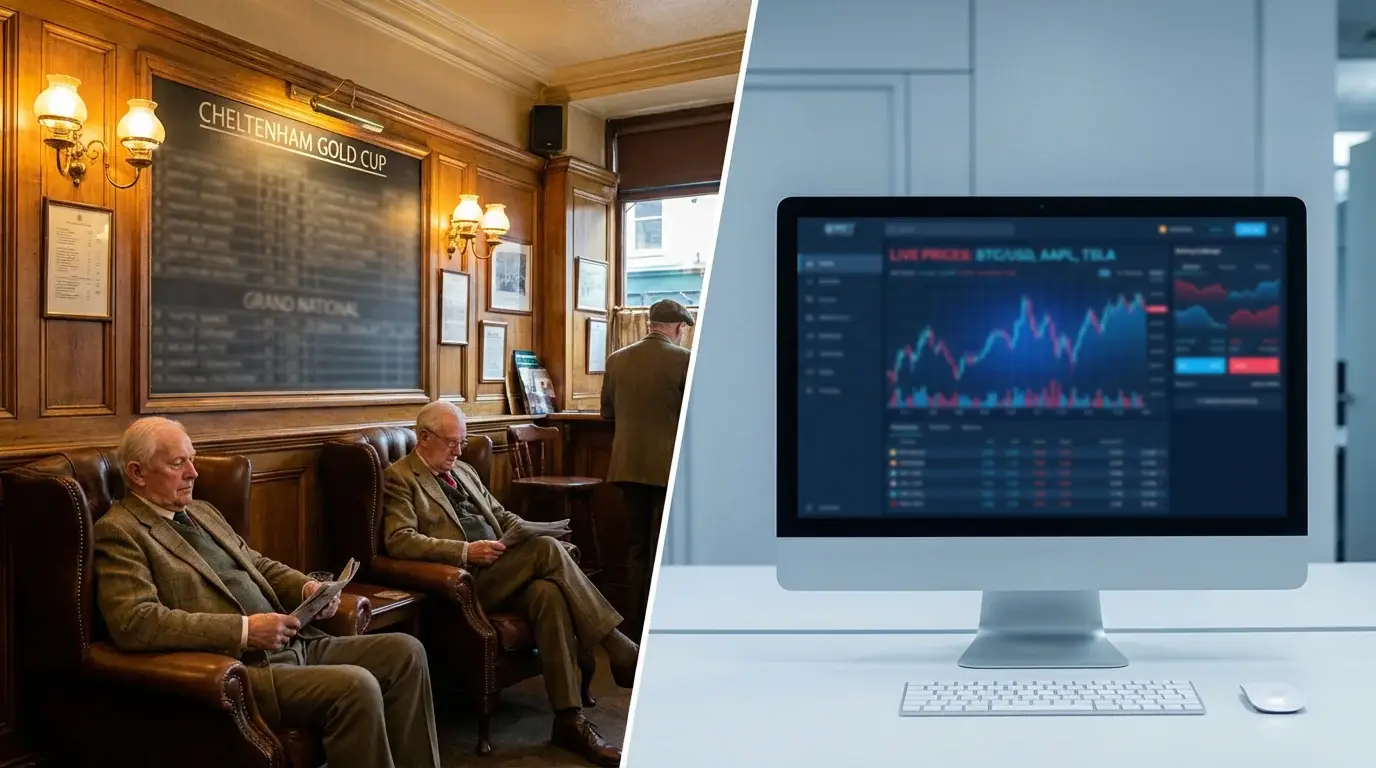
The traditional bookmaker model has existed for centuries: the house sets the odds, you accept them or walk away. Betting exchanges turned that model on its head by allowing bettors to set their own odds and trade directly with each other, with the exchange taking a small commission instead of building a margin into the price. The result is a fundamentally different betting experience — one that offers better odds, more flexibility, and the ability to bet against outcomes as well as for them.
The question of whether exchanges or bookmakers are “better” does not have a single answer. It depends on what you bet on, how you bet, and what you value. For some bettors, the bookmaker’s simplicity and promotional generosity are worth more than the exchange’s tighter odds. For others, the exchange’s pricing advantage and trading capabilities make traditional bookmakers feel like a relic. This guide compares the two models across the dimensions that matter for football betting.
Mechanics of Football Betting Exchanges
A betting exchange is a platform where bettors trade bets with each other rather than against a bookmaker. When you place a bet on an exchange, you are matched with another bettor who is willing to take the opposite side of your wager. The exchange facilitates this matching and charges a commission — typically 2-5% on net winnings — rather than building a margin into the odds.
The practical effect is that exchange odds are almost always better than bookmaker odds. On a standard Premier League match result market, the bookmaker might offer 2.00 on the home team with an overround of 5-6%. The exchange might offer 2.10 on the same outcome, because there is no built-in margin — just two bettors with opposing views meeting at a price they both accept. Over hundreds of bets, that difference in odds is the single largest factor in long-term profitability.
Betfair is the dominant football betting exchange globally, handling the vast majority of exchange volume on European football. Smarkets operates as a smaller competitor with lower commission rates (typically 2% versus Betfair’s standard 5%, though Betfair offers reduced rates for high-volume users). Betdaq is a third option with reasonable liquidity on the biggest matches but thinner markets on less popular fixtures. For most football bettors, Betfair is the exchange that matters, with Smarkets as a useful supplement for commission savings.
Lay Betting: Betting Against an Outcome
The most distinctive feature of a betting exchange is the ability to lay — to bet against an outcome. On a traditional bookmaker, you can only back: you bet that something will happen. On an exchange, you can also lay: you bet that something will not happen. Laying the home team is functionally identical to backing both the draw and the away win simultaneously.
Lay betting opens strategic possibilities that bookmakers cannot offer. If you believe a team is overvalued by the market — say, a mid-table side priced too short after a lucky winning run — you can lay them rather than trying to pick which of the other two outcomes will occur. You do not need to predict the exact result; you just need the team you laid not to win. This is particularly useful in football, where the draw makes three-way prediction harder than in two-outcome sports.
The risk profile of lay bets differs from backing. When you back at odds of 3.00, your maximum loss is your stake and your maximum win is twice your stake. When you lay at odds of 3.00, your maximum win is the backer’s stake, but your maximum loss is twice that amount — because you are effectively covering the backer’s payout if the outcome occurs. This asymmetry means lay betting requires careful stake management. Laying at long odds — say 10.00 or higher — exposes you to large potential losses relative to the small profit if the outcome does not happen.
Odds Comparison: Exchange Versus Bookmaker
The odds advantage of exchanges over bookmakers is consistent and well-documented. Studies comparing closing odds across major football markets show that exchange odds are typically 2-5% better than the best available bookmaker odds, and the gap widens further when compared to average bookmaker odds.
This advantage comes from the absence of an overround. A bookmaker’s three-way match result market might have implied probabilities totalling 106%, meaning 6% is taken as margin. An exchange market on the same match might total 101-102%, with the remaining 1-2% accounted for by commission rather than margin. The net cost to the bettor is lower on the exchange in almost every scenario.
However, the odds advantage is not uniform across all markets. The exchange’s pricing is sharpest on high-liquidity markets — Premier League match results, Champions League fixtures, major international tournaments — where large volumes of money on both sides drive the odds to efficient levels. On lower-liquidity markets — League Two fixtures, obscure international friendlies, niche player props — the exchange may have little or no available money to match, and the odds can be wider than what a bookmaker offers simply because there are not enough participants to create an efficient price.
This liquidity constraint is the exchange’s main practical limitation for football bettors who trade across many leagues. If your betting portfolio includes mainstream matches from the top five European leagues, the exchange will serve you well. If it includes matches from the Swedish second division or the Thai Premier League, you will need a bookmaker.
Trading Strategies on Football Exchanges
Trading on a betting exchange means opening and closing positions during a match to lock in profit regardless of the final outcome. The concept is borrowed from financial markets: you buy low and sell high (or lay low and back high), and the difference is your profit minus commission.
The simplest football trade is the back-to-lay. You back a team pre-match at 3.00, and after they score the first goal, their live odds shorten to 1.80. You then lay the same team at 1.80, which creates a position where you profit regardless of whether the team goes on to win, draw, or lose — because the back and lay at different prices produce a guaranteed margin. The exact profit depends on how much the odds moved and how you distribute the stakes, but the principle is risk-free profit captured from a price movement.
The reverse — lay-to-back — works when you expect odds to lengthen. You lay a team pre-match at 2.50, and if the opposition scores first, the team’s odds drift to 4.00. You then back the same team at 4.00, locking in a profit. This trade profits from the team conceding a goal, which is a useful position when you believe a team is overpriced but do not want to commit to a full lay bet that relies on them not winning.
In-play trading requires a live video feed (or at least a fast data feed), quick decision-making, and the discipline to close positions at predetermined levels rather than chasing further movement. It is closer to day trading financial instruments than to traditional sports betting, and the skill set overlaps significantly. Bettors with trading backgrounds often find exchange football trading intuitive, while those accustomed to fixed-odds betting may need time to adjust to thinking in terms of positions rather than individual bets.
Green books — distributing profit evenly across all outcomes so that you win the same amount regardless of the result — are the standard exit strategy for exchange trades. The exchange’s interface typically includes a “cash out” or “green up” button that calculates the optimal distribution automatically. This is functionally identical to the bookmaker’s cash out feature, but because you are trading at exchange odds rather than the bookmaker’s margin-laden cash out price, the execution is more favourable.
Commission Structures and Their Impact
Commission is the exchange’s equivalent of the bookmaker’s margin, and its structure directly affects your profitability. Betfair’s standard commission rate is 5% on net winnings per market, meaning if you win 100 units on a market, you pay 5 units in commission and keep 95. Smarkets charges 2%, and Betdaq typically charges 2-3%.
The difference between 2% and 5% commission is significant for active traders. A bettor who trades 100 markets per week and averages 10 units of net winning per market pays 500 units in commission on Betfair versus 200 units on Smarkets. Over a year, that gap amounts to thousands of units — real money that goes directly to the exchange rather than the bettor.
Betfair offers reduced commission rates for high-volume users through its loyalty tiers, which can bring the rate down to 2-3% for the most active accounts. If you are placing enough volume to qualify for these reductions, Betfair’s superior liquidity combined with reduced commission makes it the better choice. If you are a lower-volume exchange user, Smarkets’ flat 2% rate may produce better net results despite the thinner market depth.
Account Restrictions: The Exchange Advantage
One of the most practical advantages of exchanges over bookmakers is the absence of account restrictions. Traditional bookmakers routinely limit or close accounts that they identify as consistently profitable. This practice is frustrating and common — sharp bettors often find their stakes capped within months of opening an account, effectively shutting them out of the market.
Exchanges do not restrict accounts because their business model does not require them to. The exchange profits from commission on every transaction, regardless of whether the bettor is winning or losing. A profitable bettor who trades actively is actually more valuable to the exchange than a losing one, because they generate more commission revenue. This means you can bet — and win — on an exchange indefinitely without fear of having your account limited.
For serious football bettors who plan to bet for years rather than months, this is arguably the strongest argument for exchanges over bookmakers. The best strategy in the world is worthless if the bookmaker shuts your account before you can execute it. On an exchange, execution is guaranteed for as long as liquidity exists on the other side of your trade.
Both Models Have a Place in Your Toolkit
The answer to “exchanges or bookmakers?” is not either-or — it is both. Exchanges offer better odds, lay betting, trading capabilities, and freedom from account restrictions. Bookmakers offer simplicity, promotional value, wider market coverage for obscure leagues, and features like streaming and cash out that exchanges either lack or implement differently.
The optimal setup for most football bettors is an exchange account for core betting activity — capturing the odds advantage on every wager — supplemented by bookmaker accounts for promotions, streaming, and markets where exchange liquidity is insufficient. Use the exchange for Premier League match results at better odds. Use the bookmaker for the free bet offer on Champions League night. Use the exchange to trade live positions during a match you are streaming through the bookmaker’s platform. The two models complement each other, and the bettor who uses both intelligently has a structural advantage over the one who commits exclusively to either.
