

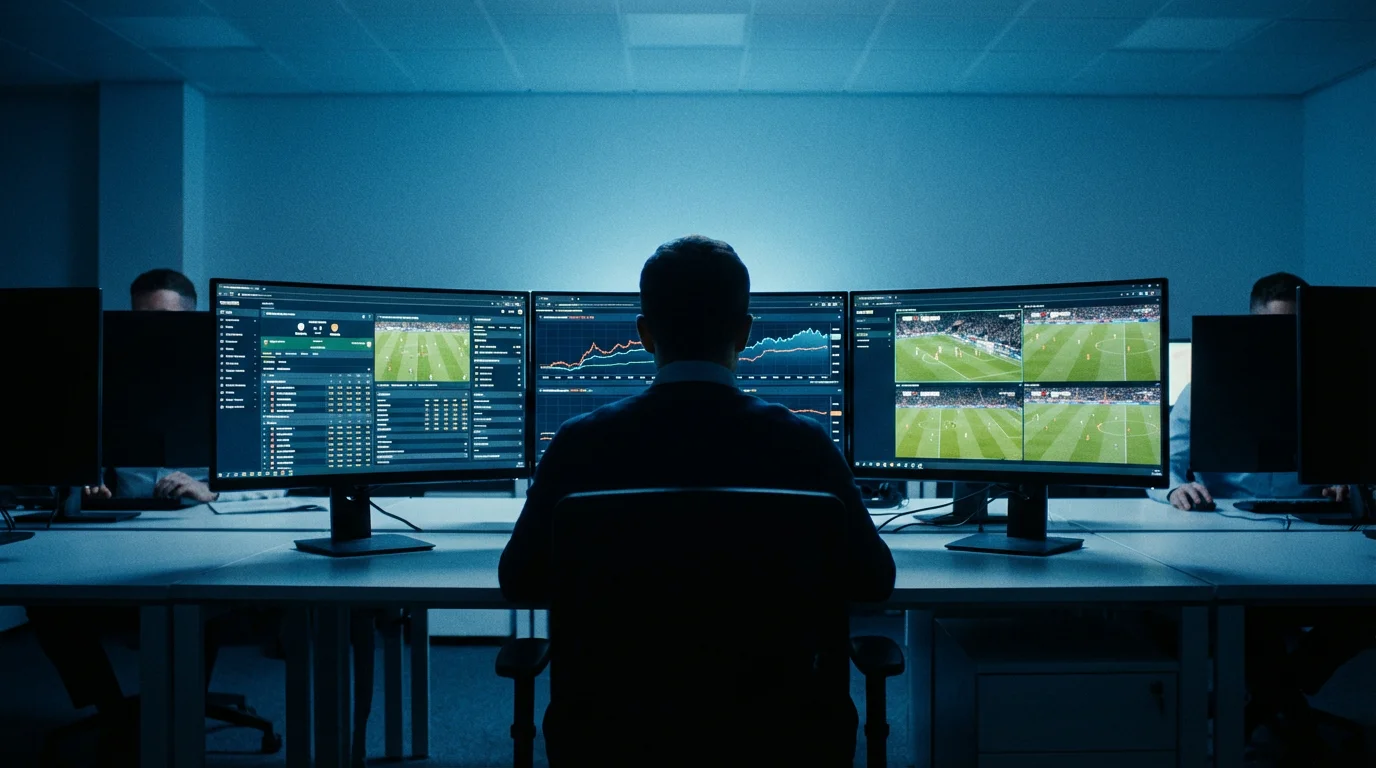
Most bettors look at odds as a given — a number on a screen that they accept or reject. Few stop to consider where that number came from, who decided it, and what forces push it up or down between the moment a market opens and the moment the referee blows the final whistle. Understanding how bookmakers set football odds does not just satisfy curiosity. It gives you a structural advantage, because knowing how the price is built reveals where the price might be wrong.
The odds-setting process is a blend of mathematics, human judgment, and market dynamics. It starts with statistical models, passes through the hands of experienced traders, responds to the weight of money from the betting public, and continues to adjust right up to and during the match. At every stage, the bookmaker is trying to achieve the same thing: a set of prices that generates balanced action on all outcomes while preserving a profitable margin.
Role of Algorithms in Football Odds Setting
Modern odds-setting begins with quantitative models. The bookmaker’s data science team builds mathematical frameworks that estimate the probability of every outcome in a football match — home win, draw, away win, and a granular breakdown of scorelines, goal totals, and secondary markets. These models ingest historical data, current-season performance metrics, team ratings (similar to Elo or power rankings), and a range of other variables to produce a probability distribution for the match.
The sophistication of these models varies by bookmaker. The largest operators — bet365, Entain (Ladbrokes/Coral), Flutter (Betfair/Paddy Power) — invest millions in quantitative infrastructure, employing teams of data scientists and machine learning engineers. Smaller bookmakers may license odds feeds from specialist providers like Sporting Solutions, Betgenius, or the Betfair Exchange’s closing prices, rather than building their own models from scratch. In either case, the algorithmic layer provides a starting point — a set of “raw” probabilities that will be refined by human input.
Expected goals (xG), shot quality data, pressing metrics, and squad strength indices all feed into these models. The best models also account for factors that simpler models miss: travel distance for European fixtures, altitude effects in South American qualifying, the historical performance of specific teams under specific referees, and the impact of managerial changes on tactical identity. The more granular the data, the more accurate the initial pricing — but no model captures everything, which is why human traders remain essential.
The Traders Who Refine the Numbers
After the algorithm produces its initial probabilities, human traders step in. A football trading team at a major bookmaker typically includes specialists for each major league or region — a Premier League trader, a La Liga trader, a Bundesliga trader — who know their markets intimately. Their job is to review the model’s output, apply contextual knowledge that the algorithm cannot capture, and set the opening odds that will go live on the platform.
The adjustments traders make are based on information that is difficult to quantify. A key player returning from a minor injury that is not reflected in the official team news. A managerial disagreement with a star player that has been reported in the local press but not picked up by international media. A historical trend in a specific fixture that the model underweights because the sample size is small. These soft factors — the intelligence that sits between the data and the odds — are what experienced traders bring to the process.
Traders also adjust the odds based on their assessment of likely betting patterns. If a Premier League match features a popular team that will attract heavy public money, the trader may shade the opening odds on that team slightly shorter than the model suggests, anticipating that the weight of public bets will push the line further in that direction anyway. This proactive adjustment is a form of risk management that also creates an opportunity for sharp bettors: if the trader has overcompensated for expected public bias, the odds on the other side of the market may be wider than they should be.
The tension between the model and the trader is productive. The model provides discipline — it ensures the odds are grounded in statistical reality rather than gut feeling. The trader provides nuance — they ensure the odds reflect the full picture rather than just the numbers. The best odds are produced when both inputs work together, which is why the most sophisticated bookmakers invest in both quantitative models and experienced trading teams.
The Overround: How the Bookmaker Guarantees a Margin
The overround — also called the vig, juice, or margin — is the mechanism that ensures the bookmaker makes money regardless of the match outcome. It works by setting odds that imply a total probability greater than 100%. In a fair market with no margin, the implied probabilities of home win, draw, and away win would sum to exactly 100%. In a real bookmaker market, they sum to 105-110%, with the excess representing the bookmaker’s theoretical profit.
For example, a bookmaker might price a match at 2.20 (home), 3.40 (draw), 3.00 (away). The implied probabilities are 45.5%, 29.4%, and 33.3%, which total 108.2%. The extra 8.2% is the overround — it is the bookmaker’s edge, and it means that the odds you receive are slightly worse than the “true” probability of each outcome would dictate.
The size of the overround varies by bookmaker, by market, and by the prominence of the match. High-profile matches — Premier League, Champions League — tend to carry lower overrounds (3-6%) because competition for betting volume forces bookmakers to offer sharper odds. Lower-profile matches — third-tier leagues, international friendlies — tend to carry higher overrounds (8-15%) because less competition and lower liquidity allow the bookmaker to extract more margin. Understanding this variance helps you choose where to bet: all else being equal, you should bet on the market with the lowest overround, because that is where your odds are closest to fair.
Market Movement: Why Odds Change Before and During a Match
Opening odds are the bookmaker’s first offer. Closing odds — the price at the moment the market suspends — are the market’s final verdict. The journey between the two is driven by the weight of money placed by bettors and by new information entering the market.
When a large volume of money lands on one side of a market, the bookmaker shortens the odds on that selection and lengthens the odds on the other outcomes. This rebalancing serves two purposes: it manages the bookmaker’s liability (reducing potential payout on the popular side) and it creates a more accurate price through the wisdom-of-crowds effect. The closing line of a football match is, on average, a more accurate predictor of the outcome than the opening line — because it has been refined by thousands of individual betting decisions, each reflecting a different piece of information or analysis.
Sharp money — bets from professional or well-informed bettors — moves lines more aggressively than public money. Bookmakers monitor their customer profiles and adjust their response accordingly: a large bet from a known sharp account may trigger an immediate line move, while the same size bet from a recreational account might not move the line at all. This tiered response is why line movement analysis is useful — when the line moves against public sentiment, it often indicates that sharp bettors have taken the other side, which is valuable information.
Team news — particularly lineup announcements that come roughly an hour before kickoff — can produce the sharpest line movements of the pre-match period. A key player’s unexpected absence can shift the match result odds by 10-15% in implied probability terms within minutes. Bettors who monitor team news and react quickly can sometimes capture value before the market has fully adjusted, though this window closes fast as the bookmaker’s traders and algorithmic systems reprice the market.
The Price Is a Product, Not a Prophecy
The most useful thing to understand about bookmaker odds is that they are not a prediction of what will happen. They are a product — a price set to maximise the bookmaker’s commercial position while remaining attractive enough to generate volume. Every price reflects a combination of statistical modelling, trader judgment, public betting patterns, and commercial objectives. Some of those inputs are analytical. Others are strategic.
Your role as a bettor is to determine whether the price on offer represents fair value for the risk involved. Sometimes it does, and the correct decision is to pass. Sometimes it does not — the odds are wider than the true probability warrants — and the correct decision is to bet. Knowing how the price was built gives you a framework for making that judgment, because it tells you where the bookmaker’s process is strongest (statistical modelling of mainstream markets) and where it is weakest (niche markets, soft contextual factors, and over-reactions to public sentiment). Those weak points are where your edge lives.
